Tower of Hanoi Schedule: the Strategy of Data Backup Rotation
Tower of Hanoi backup strategy is a data rotation method that uses an increasing number of backup media sets, each doubling the retention depth of the previous one. It is named after the classic Tower of Hanoi puzzle, in which disks are moved between three pegs so that a larger disk is never placed on a smaller one. Originally used for tape rotation, the method is now applied to disk-, cloud- and NAS-based backup storage as well.
Last updated: August 13, 2026

Tower of Hanoi Schedule: The Basic Principle of Backup System
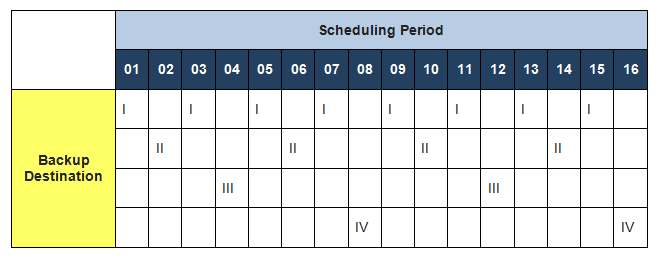
In the Tower of Hanoi backup retention scheme, the first media set is used every second day, the second media set is used when the first set is not used and is used every fourth day, the third media set is used when neither of the previous sets are used and every eighth day and so on.
Any equal quantum of time can serve as a base instead of a “day”, e.g., a minute, a 10-minute interval, a Sunday or a three-month period. Here, the term “day” is only for illustrating the basic principle.
Note: As compared to Grandfather-father-son rotation schedule, this one can employ more backup media sets and save a deeper backup history. This backup rotation schedule requires only five backup media sets to perform daily backups during a month, for instance. For a shorter, more predictable retention window, see the FIFO backup rotation scheme instead.
Tower of Hanoi vs. Grandfather-Father-Son vs. FIFO Rotation
All schemes solve the same problem — deciding which backup media set to reuse next — while balancing media count, history depth, and setup effort differently:
| Scheme | Media sets required | Backup history depth | Setup complexity | Best for |
|---|---|---|---|---|
| Tower of Hanoi | 5+ (grows slowly) | Very deep — doubles with each added set | Medium — several scheduled tasks with offset intervals | Long-term archival with a limited number of media sets |
| Grandfather-Father-Son | More sets, growing linearly | Moderate — fixed by daily / weekly / monthly tiers | Low — familiar daily/weekly/monthly logic | Predictable, easy-to-explain retention windows |
| FIFO | Fixed, defined in advance | Shallow — oldest copy is always overwritten | Low — single repeating rule | Short-term, frequent recovery points |
Recommended Solution
Lifetime license
SoHo Backup Software
The simplest Standard edition for home users fully supports all components needed for the Tower of Hanoi backup strategy, allowing saving data to three or more storage sites.
Implementing the Tower of Hanoi Backup Method in Handy Backup
To create an automatic implementation for the Tower of Hanoi backup strategy, you must make some backup tasks in a New Task Wizard, with each of these tasks copying the same dataset. Here we are providing an instruction for the “four-tower” set. Please follow the next necessary operations:
- Create a new Handy Backup task for the “first tower” backup.
- On Step 2, select the dataset to save in a Tower of Hanoi backup.
Note: For all tasks of the Tower of Hanoi backup rotation scheme, always mark the “Use advanced mode” option on Step 1. Without this option, you cannot get access to some principal features!
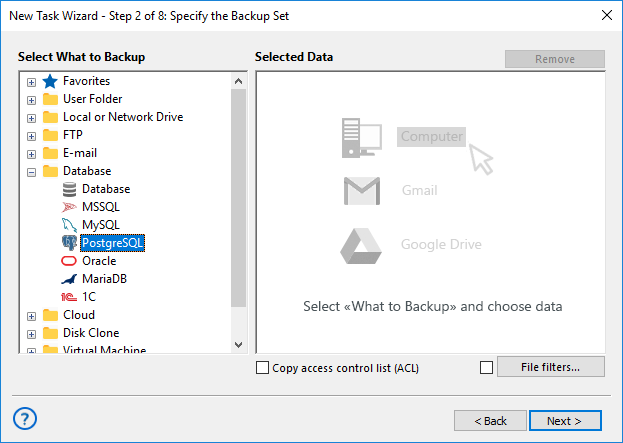
- On Step 3, select a data destination that will serve as the “first tower”.
- On Step 6, schedule this task to execute at each other day.
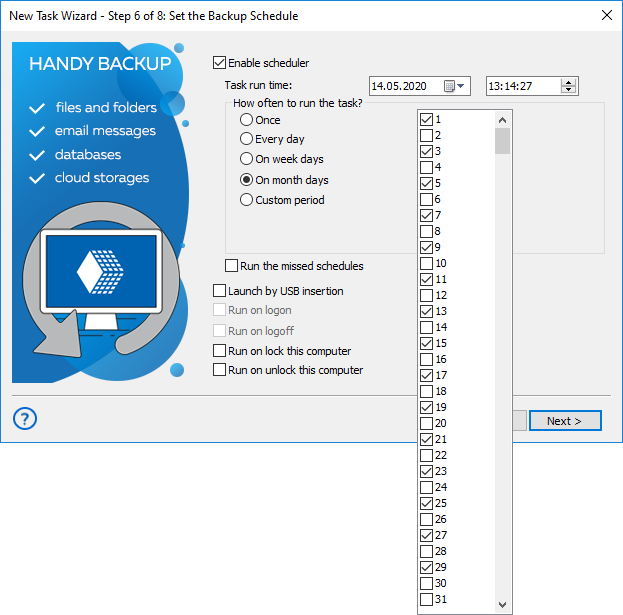
- Set the name of this task as the First Tower Backup.
- Create a new backup task and select the same dataset on Step 2.
- On Step 3, select the “second tower” backup storage.
- On Step 6, set up the backup for the second day and a repeating period of four days.
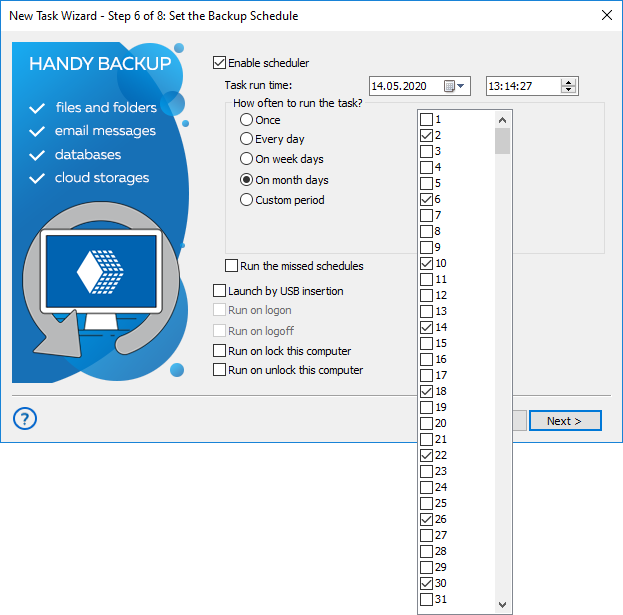
- Name this task as the Second Tower Backup. Again, create a new backup task.
- Select the “third tower” vault, and on Step 6, set up a fourth day as the starting day.
- Also, make a repeating period of eight days for this task. Name it the Third Tower Backup.
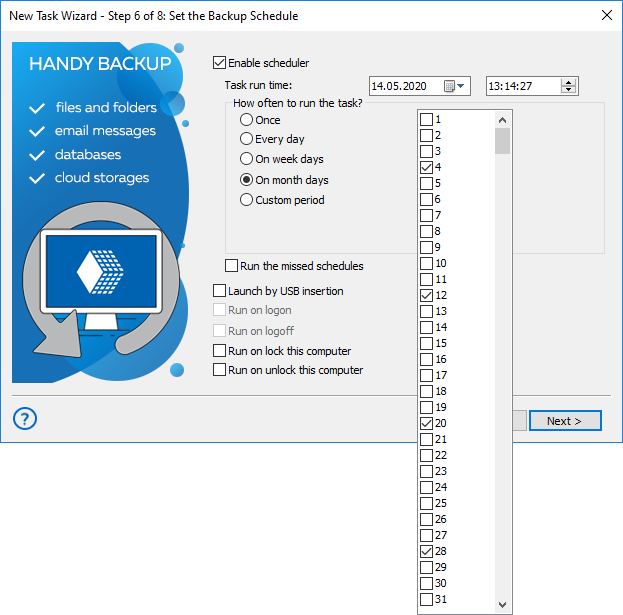
- On the last step, create another task with the same dataset and the “fourth tower” vault.
- Schedule it to start on the 8th day and a 16-day repeating period. Of course, this task will have a name like Fourth Tower Backup.
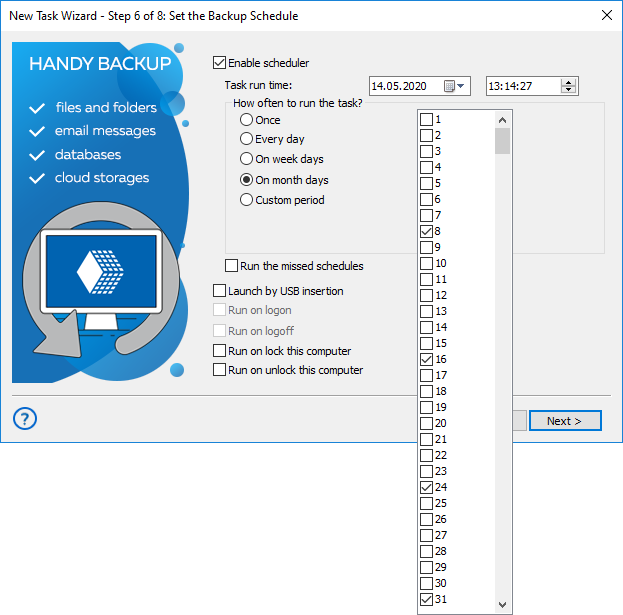
These are all the operations to set up a Tower of Hanoi backup system in Handy Backup! You can select any preferred scheduling period instead of days, and you can add any depth to this algorithm by using powers of two for an initial interval between tasks and the doubles for this interval for repeat. For related rotation strategies, see also Differential Backup and Incremental Backup.
How the Tower of Hanoi Backup Strategy Works
Each additional backup media set added to the rotation doubles the deepness of backup history. The program uses it only when the previous sets are not in use. Thus, the later a backup media set is added to the history, the older files it stores and the less time a program will use it.
Trade-off: The Tower of Hanoi scheme trades short-term recovery points for long-term history depth. A daily backup created on the first media set is typically overwritten within 2 days, so this scheme works best combined with a separate short-retention rotation — such as FIFO — for recent files.
 Download Trial
Get Handy Backup for easy implementation of Tower of Hanoi backup method!
Download a newest version for a free 30-day trial!
Frequently Asked Questions
How many backup media sets does the Tower of Hanoi scheme require?
A 5-set rotation is enough for about a month of daily backups. Each additional set roughly doubles the retention depth, allowing you to extend backup history without increasing the number of media sets proportionally.
What is the main drawback of the Tower of Hanoi backup method?
The main drawback is that the Tower of Hanoi scheme keeps relatively few recent recovery points. A frequently reused backup set may be overwritten within a short period, making this method less suitable when you need many recent copies. For better short-term recovery coverage, Tower of Hanoi can be combined with FIFO or Grandfather-Father-Son rotation.
How is Tower of Hanoi different from Grandfather-Father-Son rotation?
Grandfather-Father-Son uses fixed daily, weekly and monthly backup tiers with predictable retention periods. Tower of Hanoi uses progressively increasing reuse intervals for backup sets, allowing a deeper backup history with relatively few media sets, but requiring a more complex rotation schedule.
Related to Tower of Hanoi Backup:
Learn more:
- Grandfather Father Son Backup Strategy
"Grandfather-father-son backup is the one of most popular backup schemes, allowing saving data into the two different places with three repeating frequencies.…" - Software for FIFO Backup Rotation
"FIFO backup rotation (where FIFO is an acronym for "first in, first out") is a scheme where the newest backup replaces an oldest, with a predefined "depth".…" - Backup Retention Policy Best Practices
"Backup Retention policy is a paradigm defining a relation between quantity of backups and practical issues about keeping these backups. To optimize a…"