OneDrive Synchronization Tool
OneDrive sync software - Handy Backup helps users synchronize OneDrive data with other storage locations, including local drives, NAS, SFTP servers, and cloud storage services. Unlike the built-in Microsoft sync mechanism, which mirrors file changes within the OneDrive ecosystem, this tool allows users to create more controlled sync and backup workflows with independent storage destinations.




Handy Backup - Third Party OneDrive Sync Tool

Multi-Storage Sync
Handy Backup enables OneDrive sync with multiple storage types, including local folders, external drives, NAS, network shares, FTP/SFTP servers, and cloud accounts, helping users keep data updated across different destinations.

Multi-Cloud Sync
Handy Backup supports multi cloud sync and backup workflows with OneDrive, Google Drive, Dropbox, Amazon S3, and other S3 compatible cloud storage services, helping users keep copies of their data across several cloud destinations.
Cross-Cloud Synchronization Scenarios with OneDrive

Sync OneDrive and Dropbox
Handy Backup enables synchronization between OneDrive and Dropbox to keep data aligned across two separate cloud systems. It is useful when users or teams operate in different ecosystems. Sync tasks can run automatically on a schedule. This helps maintain consistent and up-to-date files.

Sync Google Drive with OneDrive
This scenario allows data exchange between Google Drive and OneDrive across different cloud platforms. Sync direction can be one-way or bidirectional depending on setup. It removes the need for manual transfers. Handy Backup keeps file structures consistent across both clouds.

Cloud-to-Cloud Sync OneDrive
Cloud-to-cloud sync lets OneDrive act as a source or destination in automated workflows. Data can be transferred between cloud accounts without local storage. It is useful for redundancy and backup strategies. Handy Backup centralizes scheduling and sync control.
Sync OneDrive to S3
This use case connects OneDrive with Amazon S3 for scalable cloud storage and backup. Data can be synced or periodically transferred based on needs. It adds an extra layer of protection outside Microsoft services. Handy Backup automates secure cloud-to-cloud transfers.
Advantages of OneDrive Synchronization with Handy Backup

The Independent Solution
Handy Backup is independent from a preset cloud sync tool and from the "OneDrive" folder on a local disk. It completely supports an API used in OneDrive and OneDrive for Business, allowing syncing any data and any folder to cloud storage without third-party bridges or necessity in extra software.

Many Tasks for Many Purposes
The independence brings possibilities, and you can choose not only the one folder for cloud synchronization (including OneDrive sync). Instead, you can make as many sync tasks as you need, operating with different folders, servers, cloud accounts, machines, mapped and shared resources etc.

Avoiding OneDrive Synchronization Problems Emerging In the Manual Mode
With its perfect automation, good choice of storage plug-ins and wide spectrum of different built-in tools, Handy Backup allows avoiding problems and obstacles of manual (or utility-based) synchronization actions. It does the entire job; you must only plan what to sync, and then grant access!

The Cross-Platform Solution
Handy Backup allows OneDrive sync for Linux and Windows, desktop and server applications, and even for remote network machines. It supports folders, FTP servers, clouds and virtual machine storage of most common types, allowing making OneDrive sync with almost any other data vault or folder type!
What Can I Sync with OneDrive In Handy Backup?
The simplest answer is "any storage", perhaps excluding obsolete and too rare storage types. You can make OneDrive sync for a local folder, a network drive, make an automatic Dropbox to OneDrive sync task, as well as sync OneDrive and Google Drive, an S3 bucket or even a network machine.
A Note about OneDrive for Business Sync

To use Handy Backup as OneDrive for Business sync client, you must have an appropriate plug-in for your copy of Handy backup, and also an available account in OneDrive for Business cloud. In all other details, Handy Backup works as OneDrive sync tool by identical way as for OneDrive for Business.
Recommended Solution
Lifetime license
Handy Backup Professional
Handy Backup Professional enables you to back up and synchronize OneDrive Personal and OneDrive for Business data with other storage destinations, including local drives, network storage, Google Drive, Dropbox, Amazon S3, and other S3 compatible clouds. This helps build a more flexible multi cloud sync strategy than relying only on built in OneDrive synchronization.
Customer Feedback on Handy Backup as an Independent OneDrive Sync Application
Capterra′s Rating:

"Great product, very simple and effective backup program"
How Does OneDrive Sync Works?
These are the three types of Microsoft OneDrive sync operations: "first-folder", where a selected OneDrive account is a base for sync files, "second folder", where it is a data acceptor, and "mirroring", which does OneDrive synchronization in both ways, replacing files to actual versions in both storage.
How to Make a Typical OneDrive Sync Task in Handy Backup?
For simplicity, we will demonstrate creating a OneDrive synchronization task in a simple wizard mode. You can always switch to advanced mode on Step 1, or change any advanced task parameters after creating a task in its properties window.
- Open the New Task Wizard by the "Create" button on the main panel or by pressing Ctrl+N.
- Select Sync task type, and then click "Next" without marking an "Advanced Mode" option.
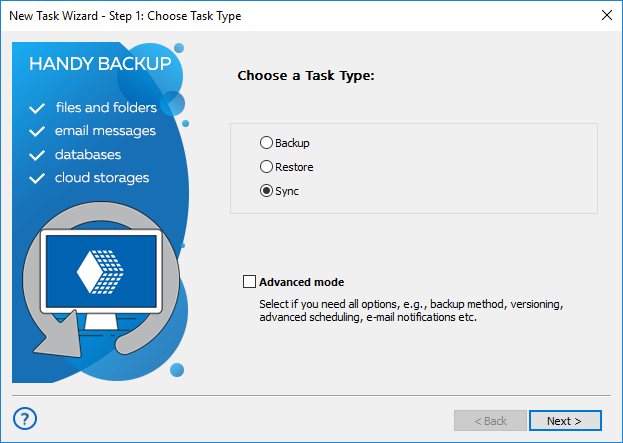
For a network solution only: on Step 2, select a remote machine to use it for sync a first folder in the upper left corner.
- On the left panel, click onto either the "OneDrive" or "OneDrive for Business" plug-in name to select a first folder. If you have no connection, click onto "Create a connection…" string.
- Select a new or existing connection to OneDrive from a list on the right panel. Choose the first OneDrive synchronization folder, and then click "Next".
- On the next step, select a second folder by repeating pp. 3-10 if necessary for creating a connection to the second folder plug-in and then for selecting a folder.
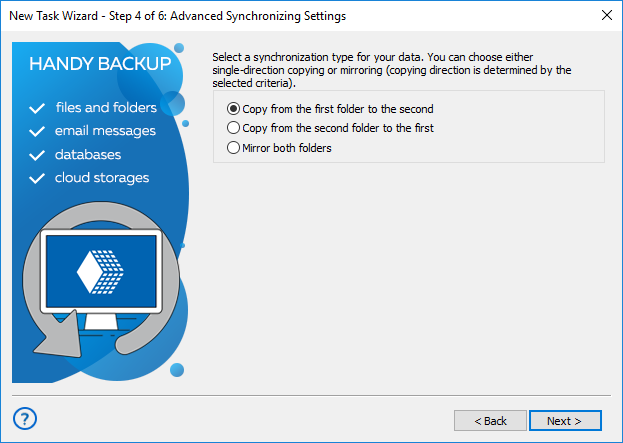
- On the next step, select the OneDrive sync settings (direction and behavior). You can copy one folder to another, or merge content for the two folders.
- Copying from the one folder to another makes all files in the "accepting" folder identical to those files located in the "source" folder (first or second, as selected).
- Mirroring the folders making the files identical in both folders. (In advanced mode, you can also set up the criteria for comparing file identity.)
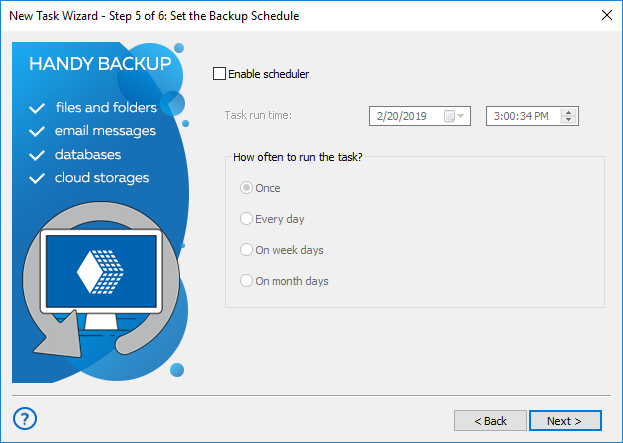
- The next step is for scheduling your task. If you plan to start it regularly by an exact time and an interval, then check the "Enable scheduler" option.
- You can select a starting time for a task and choose a repeating interval where task will run automatically time by time. In an advanced mode, you can also trigger a task to sync to OneDrive automatically by some system event, such as user logon or plugging a USB.
- The final step allows you to name your new OneDrive sync task, to take a brief review of its properties, and also to run it immediately after creating it (if you do not want it, please remove a mark from the appropriate checkbox).
This is all. You have just made an OneDrive sync task!
OneDrive Sync FAQ: Control, Risks and Advanced Synchronization Options
How do I disable automatic OneDrive synchronization?
To disable automatic OneDrive synchronization, open the OneDrive cloud icon in the system tray and go to Settings. From there, navigate to the Backup or Sync section where you can manage folder synchronization. You can turn off syncing for Desktop, Documents, and Pictures individually. This stops automatic mirroring between your device and the cloud.
However, this method only affects Microsoft’s built-in sync behavior and does not give full control over storage workflows. Handy Backup provides a more flexible approach where synchronization rules, storage targets, and scheduling can be fully customized. It allows users to avoid unwanted automatic changes across devices.
What is the difference between OneDrive sync and a real backup?
OneDrive synchronization is designed to keep files identical across devices and cloud storage in real time. When a file is changed or deleted in one location, the same action is replicated everywhere else. This ensures consistency, but it does not create independent copies of data.
A real backup works differently because it stores separate versions of data that are isolated from ongoing changes. This allows users to restore previous states even after deletion or corruption. For a detailed explanation of these differences, see onedrive backup vs sync.
How does OneDrive synchronization behave across multiple devices?
OneDrive synchronization works by continuously keeping selected folders and files identical across all connected devices. When a file is edited on one device, the updated version is automatically uploaded to the cloud and distributed to other devices linked to the same account. This ensures that all machines always display the latest version of the data.
However, this behavior also means that deletions, renaming, or accidental changes are propagated everywhere almost instantly. If multiple devices are working with the same dataset, conflicts may appear when changes happen simultaneously. In such cases, OneDrive creates conflict copies or resolves differences based on sync rules.
For more controlled multi-device synchronization scenarios across different storage types and platforms, Handy Backup allows defining independent sync tasks between PCs, servers, NAS, and cloud services without being limited to a single ecosystem.
 Download Trial
Experience Handy Backup by yourself — download a free 30-day trial edition with full set of options, including OneDrive sync plug-in!